VR Therapy That Adapts to Your Nervous System
Drag to rotate
Blind Spot · YC Application · S26
Most VR therapy plays a video at you. Ours reads your body and adapts. Built by a clinical psychologist and an ophthalmologist.
Application Answers
Click any text to edit. Synced live across collaborators.
How long have the founders known one another and how did you meet? Have any of the founders not met in person?
Placeholder. Edit me.
Who writes code, or does other technical work on your product? Was any of it done by a non-founder?
Anders built the working prototype with AI-assisted coding (Claude Code, VS Code); Muse S headband with real-time pipeline of EEG and heart rate through Python (muselsl, pylsl, websockets); and a Unity VR scene on Meta Quest 3, depicting a biofeedback orb that responds to the user's physiology live.
Shaunak co-founded the MedVR Symposium and Hackathon for VR/AR in Healthcare in 2019 and has Unity experience from building a patient education tool. He owns the visual safety protocols, eye-tracking metrics, and ophthalmology-side engineering decisions.
All technical work to date has been done by founders. No non-founder contributions.
Are you looking for a cofounder?
Open to a technical cofounder.
Company name
Blind Spot.
Backup names if trademark or domain falls through: Foveal, Saccade.
Describe what your company does in 50 characters or less
VR Therapy that Adapts to Your Nervous System47 / 50
Company URL
thepsychology.ai/lab/blind-spot. Holding URL until rebrand ships.
Demo
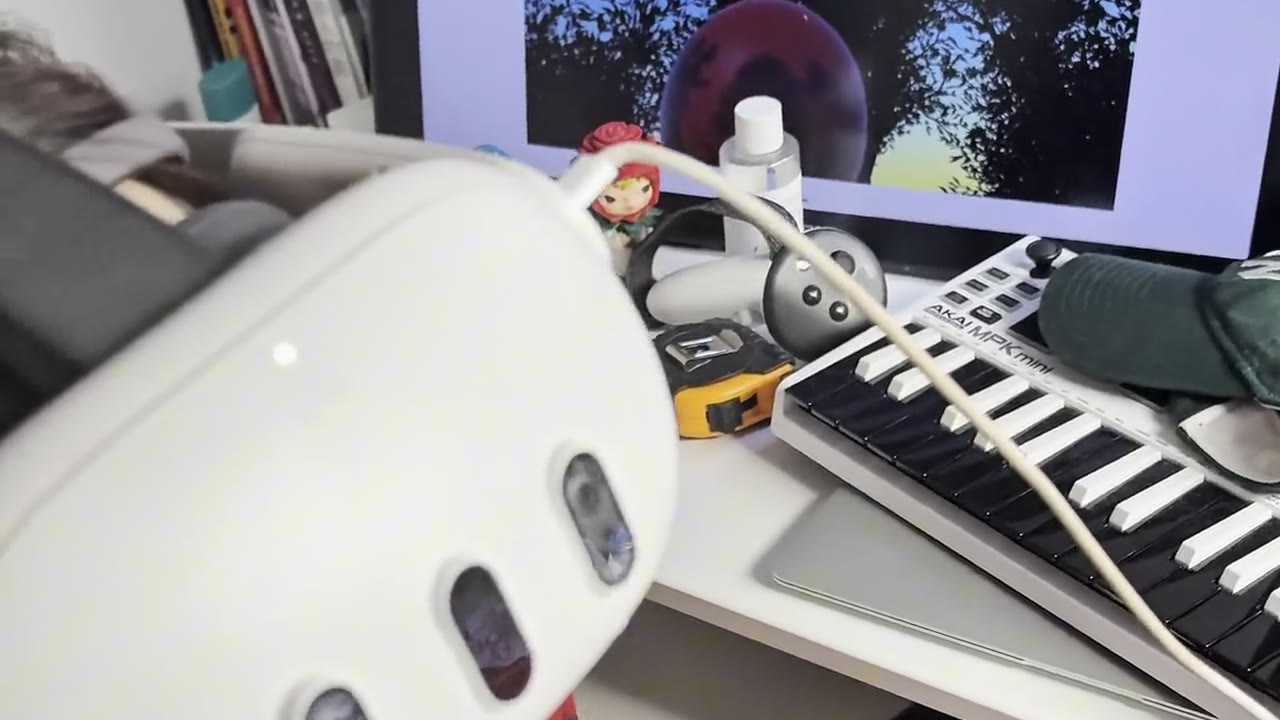
First user test
Quest 3 + Muse S, live EEG and heart rate
Tamilyn wears the Quest 3 plus Muse S. The orb expands and contracts, as she synchronizes her breathing to the rate of the VR orb expanding and contracting, her heart rate drops, which is picked up by the Muse and shifts the orb from red to green.
What is your company going to make?
Most VR therapy plays a video at you. No feedback, no adaptation. We close the loop.
Blind Spot reads your EEG, heart rate variability, and eye gaze, then changes the VR environment in real time based on what your body is doing. The system knows when you are stressed, when you are calm, and when you are avoiding eye contact. It responds.
- 01Now
Anxiety and performance
Users will be able to practice job interviews and public speaking with biofeedback by using techniques in Acceptance and Commitment Therapy (ACT), exposure (increasing difficulty/realism), and practicing coping skills in VR. Imagine Toastmasters + CBT + body monitoring. By focusing on direct-to-consumer wellness, no FDA is needed at this tier.
- 02Next
Chronic pain, FDA pathway
By creating tools for consumers and therapists to use, Blind Spot can build evidence for its benefits and a case for FDA De Novo, which could then unlock insurance reimbursement.
- 03Later
PTSD, autism, depression, surgical training
After getting approval with the largest market (chronic pain), we can build upon this engine to expand to different modules. Eye gaze alone detects depression at 86 percent accuracy in a single session. No other company has a stack that can specialize across multiple diagnoses.
Where do you live now, and where would the company be based after YC?
Boston, USA (Anders) and Vermont, USA (Shaunak). Post-YC, primary operations in NY. Clinical pilot sites maintained in Boston and Vermont.
Explain your decision regarding location
Anders is in Boston with access to Harvard, MGH, and BU for clinical pilots and research partnerships. Shaunak is in Vermont, practicing ophthalmologist with surgical expertise and a Mass Eye and Ear fellowship still in his network. Post-YC, primary operations can move to NY for XR engineering talent and digital health investors. Pilot sites stay in Boston and Vermont.
How far along are you?
Working prototype demonstrating how a VR intervention can show benefits evidenced by live EEG and heart rate.
Adjacent traction at thePsychology.ai (see revenue below).
How long have each of you been working on this? How much of that has been full-time?
Anders: 7 months full-time on thePsychology.ai. 1 month part-time on the VR prototype. 6+ years full-time in clinical (chronic pain, anxiety, PTSD, substance use, gender health) at UCLA, NYU, Montefiore, Pratt, LIU, and BCP outpatient w/ 3 years eye-gaze tracking research at SUNY Old Westbury validating eye tracking for accommodative interventions in students with disabilities. ACT chronic pain groups with sickle cell patients at Ronald Reagan UCLA.
Shaunak: 6+ years on the MedVR Symposium. 2 years in Mass Eye and Ear's Disruptive Technology Lab. 1 week ramped on this prototype.
Anders can go full-time if funded.
What tech stack are you using, or planning to use?
Unity (C#) on Meta Quest 3. Python for sensor processing: muselsl and pylsl for Muse S EEG and heart rate, Lab Streaming Layer for sync, websockets to Unity.
Roadmap: Apple Watch HRV via WatchOS plus HealthKit, Quest 3 built-in eye tracking API, Photon Fusion for shared multiplayer rooms.
AI tools: Claude Code for development.
Are people using your product?
No. Prototype stage. First real user test was 5/2/26. Video available as the demo attachment.
Do you have revenue?
Not from Blind Spot. Anders' adjacent product, thePsychology.ai, makes $320 MRR teaching postdocs to pass the EPPP licensure exam. 4 have passed.
The same brand runs an intake, scheduling, insurance verification, and payroll pipeline for Inzinna Therapy Group in a paid contract, proving we can build, sell, and retain.
Why did you pick this idea to work on? Do you have domain expertise in this area? How do you know people need what you're making?
We're both clinicians who see the gap every day.
Anders in his undergraduate research, researched neuropsychology for three years to find accommodative assessment/interventions for students with disabilities using a 10-minute task with eye-gaze tracking technology. As he trained to become a clinical psychologist, he learned to treat thousands of patients with anxiety, PTSD, and chronic pain, yet noticed that no clinics were using technology like his previous research to assist with diagnostics or interventions. It is a cultural norm to spend hours flipping through pages of the diagnostic manual and copying and pasting text in intake forms. He still believes in human clinical judgment, and using technology to enhance it can help people spend their time on their values.
Shaunak is an ophthalmologist (Harvard MD, Mass Eye and Ear cornea/refractive fellowship) with six years co-founding the MedVR Symposium. He didn't wait for VR to come to ophthalmology. He's been building that field.
The clinical limitation is obvious to both of us. VR exposure has no idea if the patient is actually anxious. Biofeedback creates no immersive context. The two have to be one system. Consumer EEG and AI coding tools finally made it buildable by clinicians.
Nobody integrates the biofeedback loop into session content.
We know people need this because we have been the clinicians wishing it existed.
Who are your competitors? What do you understand about your business that they don't?
Everyone picks two. Nobody picks all three.
- Therapy + biofeedback = no exposure. Meru Health (YC S18), Intellect (YC S21), and Muse are stuck within the app. Users have no scenarios to generalize their progress in. Bringing in VR can help users progress into more challenging scenarios at an appropriate pace.
- Therapy + VR = no feedback, no eye doctor, no range. AppliedVR (pain), EaseVRx (chronic pain, FDA-cleared), Floreo (autism), Amelia (exposure), and Limbix (shut down) all focus on one topic, which is difficult to scale. We are aiming to provide help across all topics, which allows a larger addressable market. These companies are also using open-loops, meaning they are missing the user's live feedback. By adding biofeedback, we can add a closed-loop, which takes the user's live responses to increase the accuracy of interventions. Lastly, with an ophthalmologist, we can catch the eye strain that kills retention that other companies ignore.
- VR + eye tracking = no mental health. Vivid Vision, NovaSight, and Luminopia treat amblyopia. Not humans.
Why us? A clinical psychologist and an ophthalmologist can use psychotherapy, VR, and biofeedback to translate their clinical experience to treat mental, emotional, and physical health at a new level of understanding, speed, and scale that no individual clinician or piece of technology can do at the moment.
How so? We can treat multiple diagnoses, use AI-assisted coding to develop new scenes appropriate for the user, adjust the level of exposure based off of biofeedback in real-time, and increase retention by reducing eye burnout. This combination could earn FDA, insurance compensation, and 50M users.
How do or will you make money? How much could you make?
Blind Spot could create value in six phases: D2C wellness, clinician SaaS, hospitals, enterprise wellness, FDA-cleared chronic pain, and later surgical simulation. Phases 1-4 can potentially reach ~$118M ARR before FDA, when staying in wellness, clinician-controlled tools, research/innovation budgets, and workplace wellness. FDA becomes necessary to make specific claims about diagnosing and treating conditions and could open to $300M ARR.
- 01No FDA needed
D2C anxiety, stress, and performance wellness
First phase is a VR wellness app for anxiety practice, stress control, public speaking, social confidence, and performance pressure. At scale, 1% of 43M anxiety-adjacent users at $20/month = $103M ARR. Growth starts through Anders' organic psychology/AI content, VR communities, clinician referrals, creators, and high-anxiety professionals. Paid CAC should stay around $40-$60.
- 02Clinician-controlled, no FDA needed
B2B clinician SaaS
Blind Spot sells to therapists as a $150/month clinician-controlled VR platform for sessions, at-home practice, HRV/gaze tracking, progress tracking, and insurance-ready notes; 1% of 50,000+ licensed psychologists = $900K ARR. This may avoid FDA only if clinicians use it under their own license and informed consent as a workflow, biofeedback, and support tool. thePsychology.ai workflow automations can help clinicians choose protocols, summarize biofeedback, draft notes, and save safety responses for panic, dissociation, cybersickness, or trauma activation.
- 03Innovation budgets, no FDA needed
Hospitals and health systems
Blind Spot sells to hospitals as a VR platform for pain clinics, surgery prep, oncology psychology, anxiety support, and integrated behavioral health. 1% of roughly 700 health systems × $250K/year = $1.75M ARR. This may avoid FDA only if sold first through innovation, research, and clinical workflow budgets without disease-treatment claims. Hospital sales are slow, so the entry path is paid pilots, research partnerships, innovation budgets, and clinical champions.
- 04Workplace wellness, no FDA needed
Enterprise wellness
Blind Spot sells to employers as a VR wellness benefit for stress, focus, social confidence, anxiety support, and performance. 10 companies × 10,000 employees × $120/year = $12M ARR. This stays in workplace wellness, not medical treatment, and becomes stronger after Blind Spot proves users engage, return, feel safe, and keep using the product.
- 05FDA De Novo required
FDA-cleared chronic pain
Blind Spot later expands into an FDA-cleared VR chronic pain product, likely starting with chronic lower-back pain; if expanded across chronic pain over time, 500K patients × $50/month = $300M ARR. The FDA path adds cost; the FY 2026 De Novo fee is $173,782, or $43,446 for a qualified small business, plus the real cost of studies, regulatory work, quality systems, safety testing, and documentation, likely $500K-$3M+ total.
FDA clearance can increase profit because Blind Spot can move from wellness pricing to medical-device pricing, make treatment claims, get prescribed, access payer reimbursement, and sell with more trust to hospitals and providers. AppliedVR's RelieVRx shows this path exists for chronic lower-back pain, but Blind Spot still needs product-specific studies, FDA clearance, and payer adoption. At $300M ARR, profit could be roughly $60M-$180M/year depending on whether net margin is 20%-60%.
- 06Side bet
VR surgical simulation
Blind Spot can later expand into VR surgical simulation, especially ophthalmology and eye-tracking-based training; Eyesi sells at $100K+ per program. This fits Shaunak's strength as an ophthalmologist with VR and visual safety experience, but it is not included in the base case.
| Phase | Stream | ARR potential |
|---|---|---|
| 01 | D2C wellness | $103M |
| 02 | Clinician SaaS | $900K |
| 03 | Hospitals | $1.75M |
| 04 | Enterprise wellness | $12M |
| Total | Phases 1-4 before FDA | ~$118M |
| 05 | FDA-cleared chronic pain | $300M upside |
| 06 | Surgical simulation | Not included |
Bottom line: Blind Spot can potentially reach ~$118M ARR before FDA if it stays in wellness and clinician-controlled workflows. FDA clearance adds cost, but it can unlock the bigger $300M ARR chronic pain upside and raise profit by allowing medical claims, prescriptions, reimbursement, and higher-trust hospital/provider sales.
Phases 1-4 stack to ~$118M ARR without FDA. Phase 5 is the lottery ticket. Phase 6 is the side bet.
Which category best applies to your company?
Consumer Health and Wellness initially. Healthcare / Digital Health post-FDA.
Other ideas considered
- VR for surgical training only (Shaunak's domain, Eyesi at $100K plus). Narrower market. Kept as a future module on the same platform.
- AI therapy chatbot with voice. Skipped due to regulatory complexity, crowded market (Woebot, Wysa), and our view that immersive VR plus biofeedback is a fundamentally different and more effective modality than text or voice.
- VR vision therapy (amblyopia, strabismus). Proven market with FDA precedent (Luminopia, NovaSight). We chose the harder bridge between vision science and mental health. Nobody else occupies that intersection.
Have you formed any legal entity yet?
No.
Have you taken any investment yet?
No.
Are you currently fundraising?
No.
What convinced you to apply to Y Combinator?
During a YC event in Boston two weeks ago, accepted founders reflected that some got in pre-product on the strength of the team and idea. Anders texted Shaunak immediately. A week later, they made a working prototype.
A psychologist with eye-tracking research and an ophthalmologist who has been organizing healthcare VR/AR for six years is the kind of domain-expert founding team YC backs in healthcare. Meru Health (S18) and Intellect (S21) show the pattern. We're clinicians who see the gap daily, not technologists looking for a healthcare application.
How did you hear about Y Combinator?
YC event in Boston, YC podcast, and general awareness in the startup community.
Batch preference
Summer 2026.