Blog / What Practice Exam Score Predicts Passing the EPPP?
What Practice Exam Score Predicts Passing the EPPP?
In our data, 83% on a full-length, timed practice exam before test day is the score that has predicted a pass. Twenty-eight people have reported real EPPP results to us. Twelve of them took a full-length sim first. The eleven who peaked between 83% and 93% passed. The one who never crossed 75% did not.
That last sentence is new, and it is the reason this post exists.
Two weeks ago I wrote that nobody who failed had taken a full-length practice exam before test day. That was true at twenty-three results. It is not true at twenty-eight. One member took more than a dozen full sims with us and did not pass. I am retiring the old sentence. What replaced it is narrower and, I think, more useful.
How we collect this, so you can judge it yourself: we ask every member who sits for the real exam to write back, pass or fail. Twenty-seven have used the score report form, and one more told me in feedback. Seventeen passed, eleven did not. These are collected reports, not a pass rate. They are only the people who chose to tell us. I am a clinical psychologist and I will not dress twenty-eight data points up as a clinical trial. But the split is clean enough to change what I tell people, and it changed what the product does, so here it is.
What practice exam score predicts passing the EPPP?
Every passer whose prep we can see peaked at 83% or better on a full-length, timed practice exam before test day. Eleven of eleven. The best sim tracked the real scaled score loosely, not tightly. Nobody who peaked at 83% or higher scored under 538.
| Best full-length sim before test day | Real scaled scores reported |
|---|---|
| 83% to 84% | 600, 611, 630 |
| 86% to 89% | 538, 570, 594, 600 |
| 92% to 93% | 661, 711 |
Two things to read off that table. First, the practice number carries real information. Nine people, and the order roughly holds. Second, it is not a formula. An 89% produced a 538 on a second attempt and a 594 on a third. The same practice score can land a hundred points apart on the real thing, which is why I call it a readiness line and not a prediction of your score.
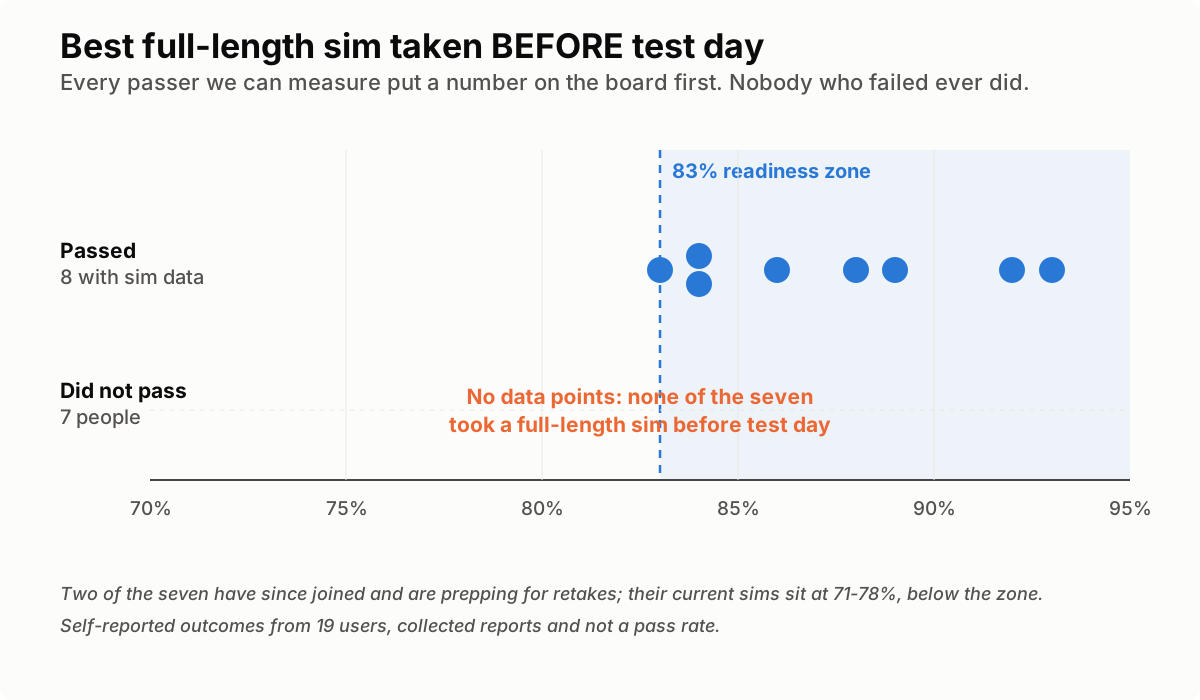
Does taking practice exams cause you to pass?
No. The number predicts a pass. Taking the exam does not produce one.
I want to be careful here, because "everyone who took a sim passed" is exactly the kind of line that sells prep courses. Look at who is in each group. The people who passed found us a median of 47 days before their exam. The people who did not pass and had used us at all found us a median of 8 days before. Five of the eleven fails had zero minutes with us before test day. They joined after, to prepare for a retake. Some of the gap is the method. Some of it is who chooses the method, and when. I cannot separate those two with twenty-eight self-reports, and neither can anyone else.
Here is the cleaner claim, and it is the one the new fail supports rather than undermines. The score on a full-length sim told the truth in both directions. Above the line, people passed. Below it, the one person we can measure did not. Effort did not decide it. More than a dozen sims did not decide it. The number saw it coming.
What did the eleven who did not pass have in common?
Ten of the eleven never took a full-length practice exam before test day. Not one. Five of those ten had no activity with us at all before their exam. The other five had a week or less: 18 minutes, 50 minutes, an hour, ten hours, sixteen hours. Real studying, some of it, but none of it a four-hour timed sitting that produced a score.
The eleventh is the one who changes the finding. This member did everything the old advice said. More than a dozen full sims. A best score that never crossed 75%. A last sim, days before test day, that was still below the line.
The readiness meter was saying not yet. The exam date was already booked.
I am keeping the details vague on purpose, as always. We never publish anything that could identify someone from their data. But the shape matters, because it is the shape most people are in when they ask me whether they are ready. Lots of work. A number that is rising but has not crossed. A date on the calendar that feels immovable.
What we changed so the next person in that spot knows what to do
When someone does everything our advice said, takes sim after sim, and still comes up short, that is not a member who studied wrong. It is a place where we can be clearer. The number was saying not yet. The program should have said, just as plainly, what to do next. That is on us. So here is what we improved.
Think of it the way you would think about a case. Session after session, the client is not meeting the treatment goals, and nobody sits down to ask why. Maybe the diagnosis is off. Maybe the plan needs adjusting. Maybe the plan is right and the way it is being carried out needs to change. More sessions alone will not answer that. A sim is the session. The plan between sims is the case review.
- After a full sim, the exam page now points at your weakest lesson, not at another exam. For a member who has taken a sim and is still under the line, the start card on the exam page is the lesson the plan ranks first, and the mock exam is the secondary button. The card says why: passers fixed gaps between mock exams, not by taking more of them.
- More exams, and a repeat can no longer rewrite your plan. Our library was sixteen full exams, so anyone who worked through all of them started seeing them again. This week it became twenty, with more than 800 new questions across the bank, and none of the four new exams shares a question with the others. We are also building enough reserve questions that a lesson quiz never repeats an exam question, and rebuilding the short diagnostics that overlapped the mocks. If you do get a repeat, the exam header now says so, and the plan ignores it, because a score on questions you have already seen measures memory of our items, not the material.
- Your real score report now builds your plan, and the plan is measured against the bank instead of in the raw. Those three changes came out of the score-report comparison below, so they are explained there.
None of this changes the readiness line. It changes what the program tells you to do when you are under it, which is the part we needed to make clearer.
What should you do when your number says not yet?
Move the date if you can. If you cannot, the work between sims is where the number moves, and that is the part the product now leads you to instead of leaving it to you.
Two ways of studying look like work and do not move the number. The first is sims only. A full-length exam builds stamina and tolerance for the four-hour room, which you need, but it teaches nothing on its own. A dozen of them in a row is a dozen measurements of the same gaps, scrimmage after scrimmage with nobody watching the tape. The second is studying everything evenly. Rereading every domain feels thorough, but the exam is not even, and neither are your gaps. Assessment and Ethics are 16% of the exam each. Research is 7%. The plan ranks domains by weighted gap, how far under you are times how much of the exam it is, because that is where a study hour returns the most points. Study what it recommends, in that order, and confirm with the next sim.
A full-length sim measures. It does not teach. A dozen sims is a lot of measuring. If the number rises a few points across a dozen of them and stays under the line, the work in between is not reaching the domains that keep costing points, and the product owes you a clearer path to them. That path is now the default: take the sim, let the exam page hand you the lesson your plan ranks first, drill that domain until a targeted quiz says you stopped missing it, then take the next sim to confirm. Accuracy first, then volume. The passers did it in that order, and the product now walks you through it in that order. More detail in how to spend the last week before the EPPP.
If you have sat for the exam before, the same logic applies with one difference: you already have a domain breakdown from the real thing. Use it. More on that below, and in the best EPPP prep for retakers.
Does the official score report match what Prioritize said was weak?
Partly, and the mismatch taught me something. Six members uploaded photos of their ASPPB score report, the page with the eight domain bars. I compared each person's real bars against the three domains our Prioritize page had flagged for them. The match was partial at best, and the misses were not random.
Our question bank is hardest in Research Methods and Statistics. Across more than a thousand stored practice exams, members miss about 25% of Research questions and about 11% of Ethics questions. So a member who misses a normal share of Research questions looks weak in Research, and a member who misses more Ethics questions than usual still looks fine, because the bar is low. Prioritize was reading the bank's difficulty as the member's weakness. On the real bars, Research was a genuine soft spot for some people and a strength for others, and the platform could not tell them apart.
The clearest case was a retaker on a fourth attempt. Their real report showed Growth and Lifespan as the weakest domain. Our diagnostic had asked nine Growth questions, they got eight right, and the plan skipped Growth entirely and sent them to Treatment, which their real bars showed as a strength. Thirteen days before a fourth attempt.
That is on us to get right, not on the member, so I changed the product. Three things, all of them about being clearer with you about what to study:
- A real score report now seeds your plan. If you report a previous attempt and mark the domains your official report flagged, Prioritize builds your plan from that, and a short diagnostic can no longer overwrite it. A full-length sim taken later can, because that is fresher evidence.
- Domain weakness is measured against the bank, not in the raw. A domain has to be worse than the bank's average for that domain to rank as a priority. Research no longer wins by being hard.
- Small samples get less say. Nine questions is not enough to clear a domain. A diagnostic's per-domain results are shrunk toward the bank average until there is enough evidence to move them.
None of this changes the readiness line. It changes what you study between sims, which is where the line actually moves, and it puts that on the screen instead of in a blog post.
What should you do with your number?
Turn the question into arithmetic. A full sim takes about four hours. If your exam is eight weeks out, you have six or seven realistic chances to run one. Take one this week, timed, in one sitting, and score it honestly.
- 83% or better: you are in the range every passer we can measure occupied. Schedule, and keep taking a sim every week or two, because readiness is something you hold until test day, not a badge you earn once.
- 79% to 82%: still no reported results either way. Treat this as unproven, not safe. Drill your weakest domains for a week or two and clear 83 before you book.
- 78% or below: this is where the one measured fail sat, and where both of our earlier retakers sat before they started climbing. Do not book yet. Fix the plan between sims, then retest.
- No sim yet: you share that with ten of the eleven people in this data who did not pass. Fix it this week, before it costs you an exam fee. One passer never took a sim, but they arrived with months of prep elsewhere and an exam the next day. If that is not you, take the sim.
What happens next in this data?
Two members who joined after failing have now cleared 84% and 86% on a full sim and sit for their retakes this month. Both were below the line when they arrived. Both climbed. If the line holds from the retaker side too, that is the next post. If it does not, that is also the next post.
Frequently asked questions
Is the readiness line 80% or 83%?
The readiness meter on the dashboard draws the line at 80%. Every passer we can measure peaked at 83% or better. The one measured fail peaked just under 75%. Nobody has reported a result from between 75% and 82%, so the meter's 80 is a floor with no data directly on it. Treat 80 to 82 as unproven and clear 83 before you book.
Does a full-length practice exam score predict your real EPPP score?
Loosely. In nine reports with both numbers, higher practice peaks went with higher scaled scores, and nobody who peaked at 83% or higher scored under 538. But the same 89% practice peak produced a 538 and a 594, so the practice number predicts readiness, not your exact score.
How many people is this based on?
Twenty-eight reported results as of September 2026: seventeen passed, eleven did not. Twelve of the twenty-eight took a full-length sim before test day, and those twelve are the ones the readiness line is built on. This is a collected sample, not a pass rate, and it will change as more people report.
Do retakers need full-length sims?
Sometimes not. One member passed on a fourth attempt with zero sims and targeted quizzes, because real attempts had already given them the four-hour-room experience. But for a retaker the more important input is the official score report from the last attempt, which now seeds the Prioritize plan directly.
What counts as a full-length practice exam?
At least 150 questions in one timed sitting. Our full sims run 180 questions. A 79-question diagnostic does not count, and neither does a topic quiz. The readiness line is about the four-hour version, where question 140 happens to your brain.
Find your number before the exam finds it for you
Every result in this post came from someone generous enough to report back, pass or fail. If that is you, write in. The next person reads their runway off your data point.
And if you have never taken a full-length, timed EPPP practice exam, that is the one thing to change this week. Take one on thePsychology.ai, where a readiness meter tracks your best score against the line. It is free for a week, which is exactly long enough to take one sim and replace "am I ready?" with a number.

Anders Chan, Psy.D. is a licensed psychologist and the founder of thePsychology.ai. He passed the EPPP on his first attempt with a score of 588 after starting from a 19% diagnostic.